Introduction: This Is Not an Ethics Story — It’s a Systems Story
Most trust accounting failures are not sudden.
They don’t start with fraud.
They start with:
- loose processes
- informal habits
- small shortcuts
And then, over time:
👉 those gaps compound into exposure.
A recent West Virginia case involving allegations of mishandling client funds offers a clear example of how operational weaknesses can escalate into serious consequences.
For context, you can review the original reporting here:
👉 https://www.legalnewsline.com/west-virginia-record/harris-indicted-on-42-counts-of-mishandling-client-funds/article_0e6f6af2-aab1-42ce-8679-4adaf39ac152.html
This article is not about the allegations themselves.
It’s about what lawyers should take away from them.
The Core Reality: Trust Accounting Is an Operational Discipline
Every lawyer knows Rule 1.15.
But knowing the rule is not the same as implementing it.
Trust accounting requires:
- structured workflows
- documented controls
- consistent reconciliation
- clear separation of funds
Without those, compliance becomes dependent on:
- memory
- intention
- “what usually works”
That’s where risk begins.
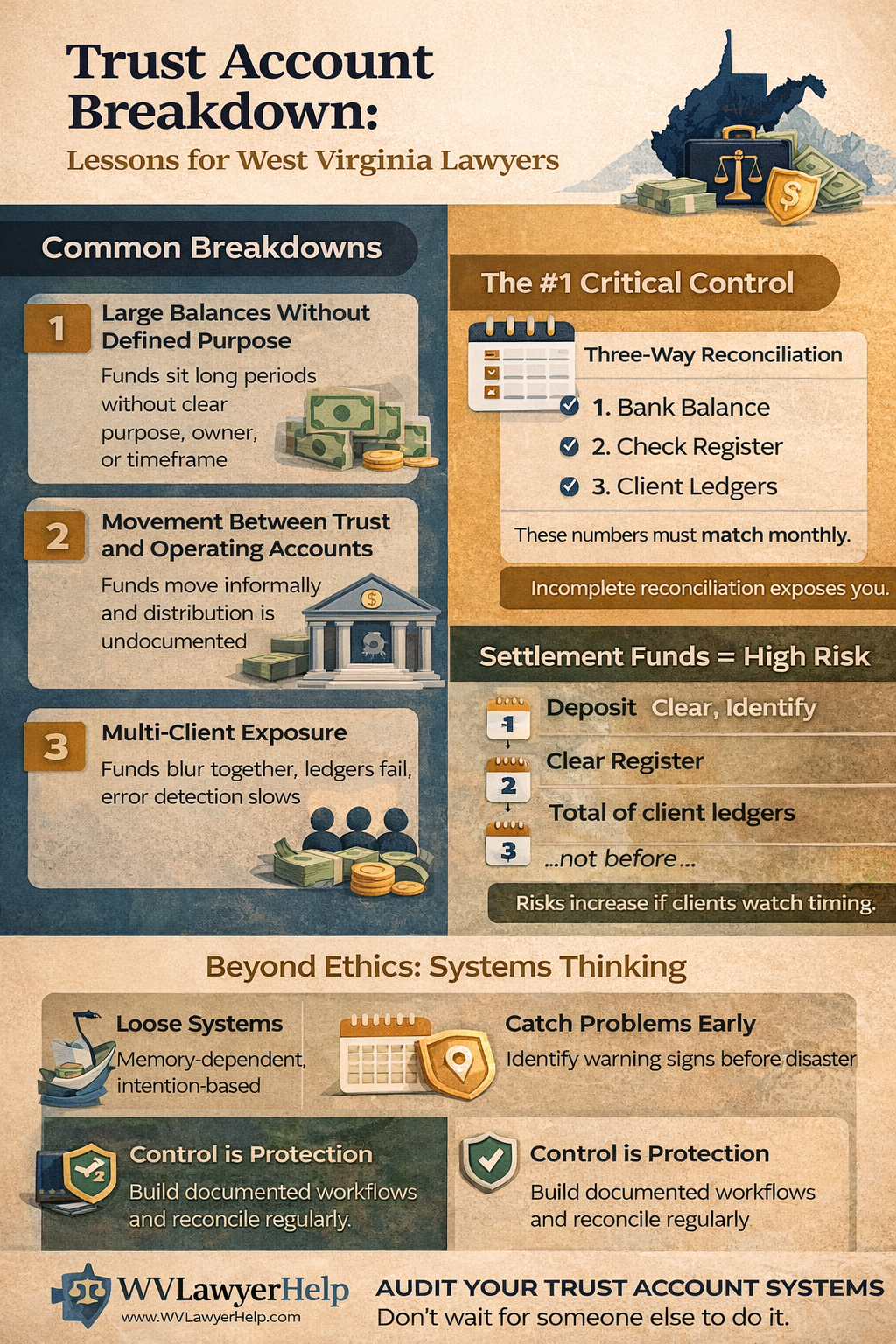
Pattern #1: Large Balances Without Defined Purpose
In many trust accounting failures, funds remain in trust for extended periods.
This creates ambiguity:
- What is this money for?
- Who does it belong to?
- Why hasn’t it moved?
Best practice:
👉 Every dollar in trust should have:
- a defined owner
- a defined purpose
- a defined timeline
Anything else is exposure.
Pattern #2: Movement Between Trust and Operating Accounts
This is where systems either hold — or fail.
Funds should only move:
- when fees are earned
- when expenses are incurred
- when distribution is documented
Breakdowns occur when:
- transfers happen informally
- documentation lags behind
- timing is inconsistent
👉 This is how small issues become large ones.
Pattern #3: Multi-Client Exposure
One of the most dangerous breakdowns occurs when:
👉 The system stops treating each client separately
Instead:
- funds blur together
- ledgers become unreliable
- reconciliation becomes difficult
At that point:
- errors multiply
- detection slows
- risk accelerates
The Most Important Control: Three-Way Reconciliation
If there is one habit that prevents disaster, it is this:
Monthly Three-Way Reconciliation
You must reconcile:
- Bank balance
- Check register
- Total of client ledgers
If these do not match:
👉 You have a problem.
And the longer it goes unresolved, the harder it becomes to fix.
Settlement Funds: The Highest-Risk Event in a Law Firm
Settlement disbursement is where trust accounting is most visible.
It is also where failures are most likely to be discovered.
Why?
Because:
- clients are watching
- amounts are large
- expectations are high
Proper Workflow
- Deposit funds
- Confirm clearance
- Identify all obligations
- Prepare written settlement statement
- Disburse
No shortcuts.
Common Failure Points
- disbursing before funds clear
- incomplete accounting
- verbal explanations instead of documentation
👉 These are operational failures, not ethical gray areas.
The Solo & Small Firm Reality
In smaller firms, risk is amplified.
Why?
Because:
- fewer controls
- limited separation of duties
- heavier reliance on the attorney
What You Need Instead
A system:
- documented workflows
- monthly reconciliation schedule
- clear deposit/disbursement rules
- review checkpoints
Because without structure:
👉 trust accounting becomes personality-driven
The Misconception: “Good Intentions Are Enough”
They’re not.
Trust accounting is not about:
- honesty
- effort
- experience
It is about:
👉 repeatability and documentation
Every dollar should be:
- traceable
- explainable
- supported
Early Warning Signs Inside a Firm
Before a major issue appears, there are signals:
- reconciliation is skipped or delayed
- ledgers don’t match balances
- funds sit without clear purpose
- documentation is incomplete
These are not minor issues.
They are early-stage failures.
Final Insight: Audit Yourself Before Someone Else Does
Most trust accounting disasters:
- build slowly
- remain hidden
- become visible too late
The solution is simple — but not easy:
👉 build systems that catch problems early
Because once trust accounting breaks:
👉 it is rarely just an accounting problem
Closing Thought
If your firm’s trust accounting depends on:
- memory
- trust
- informal processes
It is already at risk.
Because in trust accounting:
👉 control is protection
Leave a Reply