WV Lawyer Help

We help WV attorneys grow their caseload through smarter marketing, better tracking, and qualified client referrals.

Author: Admin

  • ⚖️ Lawyer POV: What HB 4191 Means for Employers, Families, and Compliance

    West Virginia’s new child care law (HB 4191) is more than a policy shift—it’s a structural change in how child care is funded, regulated, and integrated into the workforce.

    1. Employer Tax Credits = Strategic Opportunity (and Complexity)

    The law introduces two major credits:

    • 50% capital investment credit for building or expanding child care facilities
    • 50% operating cost credit for providing or sponsoring care

    These credits can:

    • Offset up to 100% of tax liability
    • Be carried forward (3–5 years depending on type)

    💡 Legal takeaway:
    This creates a new advisory lane for attorneys working with:

    • Mid-sized employers
    • Nonprofits (especially with transferable credits)
    • Multi-entity ownership structures

    But it also introduces recapture risk if the property use changes—something clients need to understand upfront.


    2. New Compliance Burdens for Providers

    The law mandates:

    • Electronic attendance reporting by July 1, 2026
    • Strict documentation tied to subsidy eligibility

    💡 Legal takeaway:
    This is a compliance and audit exposure issue.

    Providers now face:

    • Data reporting requirements
    • Potential reimbursement disputes
    • Increased regulatory oversight

    This opens the door for:

    • Administrative law work
    • Compliance consulting
    • Dispute resolution

    3. Subsidy Cliff Reform = Policy Shift with Legal Implications

    The statute explicitly targets the “benefits cliff” by allowing:

    • Gradual phase-outs of assistance
    • Expanded eligibility thresholds
    • Sliding-scale copayments

    💡 Legal takeaway:
    This introduces rulemaking discretion for the Department of Human Services.

    Translation:

    • The real impact will depend on future regulations
    • There may be litigation or challenges around implementation
    • Administrative advocacy will matter

    Bottom Line (Lawyer POV)

    HB 4191 is not just a family policy—it’s:

    • A tax strategy tool
    • A compliance regime
    • A regulatory framework still being built

    For attorneys, this is a chance to:

    • Advise employers on workforce benefits strategy
    • Help providers navigate compliance risk
    • Monitor and shape rulemaking as it unfolds
  • Device Security: Laptops, Phones, and Lost Devices

    Device Security: Laptops, Phones, and Lost Devices

    A lawyer’s practice does not stay in the office. It travels in laptops, phones, tablets, and portable drives. That means device security is really data security.

    What law firms should assume

    Devices will eventually be lost, stolen, damaged, or left unattended. Security planning should assume that this will happen and should focus on reducing the consequences.

    Core controls

    • Turn on full-disk encryption.
    • Require strong screen locks.
    • Enable remote wipe where available.
    • Keep operating systems and apps updated.
    • Separate business and personal device use where practical.

    The right mindset is simple: if a device disappears today, what protects the client information that was on it yesterday?

  • How to Convert a Word Document to a PDF

    Convert Word documents to PDF to preserve formatting and reduce editing.

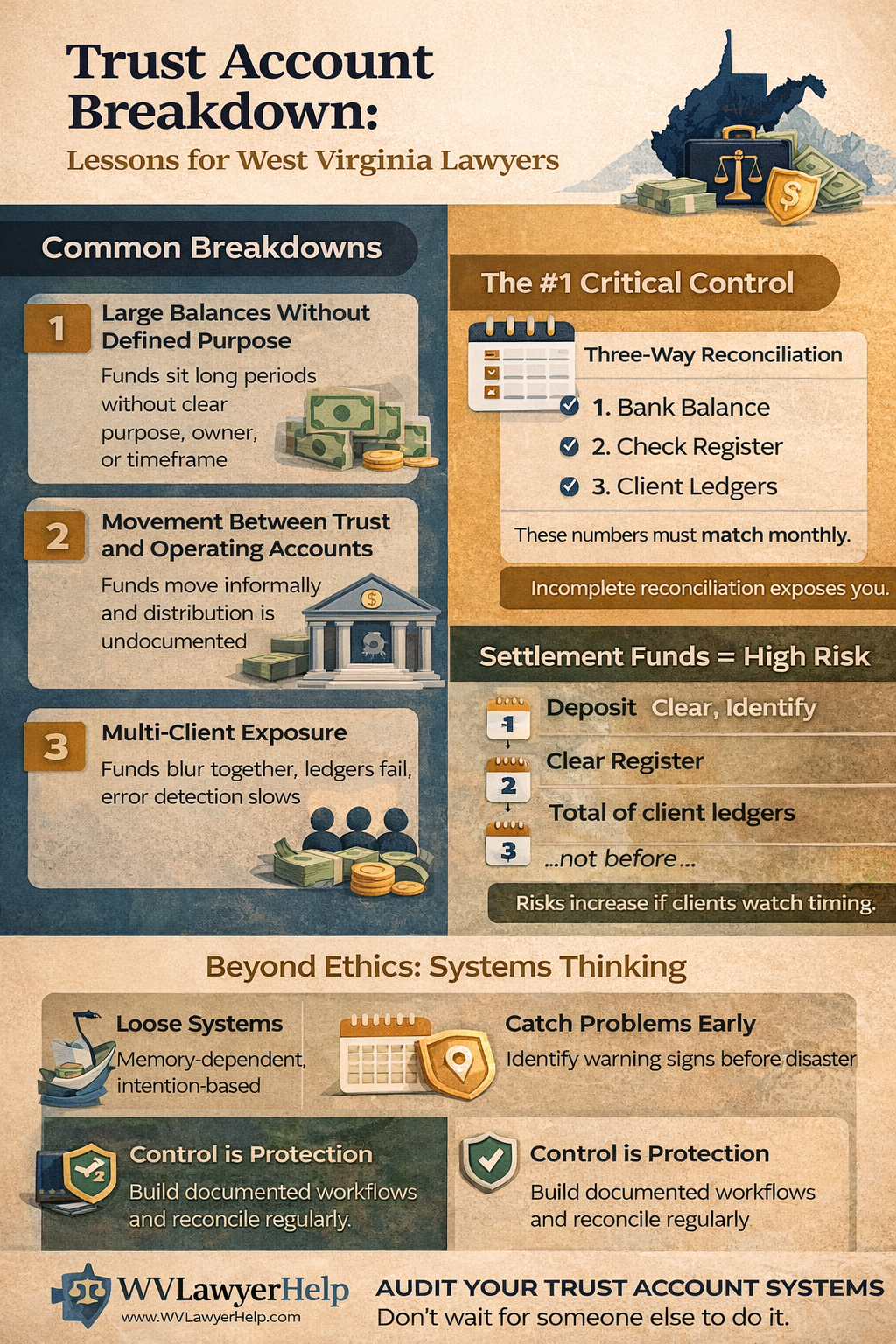
  • Trust Accounting Breakdown: What the Harris Indictment Teaches West Virginia Lawyers

    Trust Accounting Breakdown: What the Harris Indictment Teaches West Virginia Lawyers

    Introduction: This Is Not an Ethics Story — It’s a Systems Story

    Most trust accounting failures are not sudden.

    They don’t start with fraud.

    They start with:

    • loose processes
    • informal habits
    • small shortcuts

    And then, over time:

    👉 those gaps compound into exposure.

    A recent West Virginia case involving allegations of mishandling client funds offers a clear example of how operational weaknesses can escalate into serious consequences.

    For context, you can review the original reporting here:
    👉 https://www.legalnewsline.com/west-virginia-record/harris-indicted-on-42-counts-of-mishandling-client-funds/article_0e6f6af2-aab1-42ce-8679-4adaf39ac152.html

    This article is not about the allegations themselves.

    It’s about what lawyers should take away from them.


    The Core Reality: Trust Accounting Is an Operational Discipline

    Every lawyer knows Rule 1.15.

    But knowing the rule is not the same as implementing it.

    Trust accounting requires:

    • structured workflows
    • documented controls
    • consistent reconciliation
    • clear separation of funds

    Without those, compliance becomes dependent on:

    • memory
    • intention
    • “what usually works”

    That’s where risk begins.


    Pattern #1: Large Balances Without Defined Purpose

    In many trust accounting failures, funds remain in trust for extended periods.

    This creates ambiguity:

    • What is this money for?
    • Who does it belong to?
    • Why hasn’t it moved?

    Best practice:

    👉 Every dollar in trust should have:

    • a defined owner
    • a defined purpose
    • a defined timeline

    Anything else is exposure.


    Pattern #2: Movement Between Trust and Operating Accounts

    This is where systems either hold — or fail.

    Funds should only move:

    • when fees are earned
    • when expenses are incurred
    • when distribution is documented

    Breakdowns occur when:

    • transfers happen informally
    • documentation lags behind
    • timing is inconsistent

    👉 This is how small issues become large ones.


    Pattern #3: Multi-Client Exposure

    One of the most dangerous breakdowns occurs when:

    👉 The system stops treating each client separately

    Instead:

    • funds blur together
    • ledgers become unreliable
    • reconciliation becomes difficult

    At that point:

    • errors multiply
    • detection slows
    • risk accelerates

    The Most Important Control: Three-Way Reconciliation

    If there is one habit that prevents disaster, it is this:

    Monthly Three-Way Reconciliation

    You must reconcile:

    1. Bank balance
    2. Check register
    3. Total of client ledgers

    If these do not match:

    👉 You have a problem.

    And the longer it goes unresolved, the harder it becomes to fix.


    Settlement Funds: The Highest-Risk Event in a Law Firm

    Settlement disbursement is where trust accounting is most visible.

    It is also where failures are most likely to be discovered.

    Why?

    Because:

    • clients are watching
    • amounts are large
    • expectations are high

    Proper Workflow

    1. Deposit funds
    2. Confirm clearance
    3. Identify all obligations
    4. Prepare written settlement statement
    5. Disburse

    No shortcuts.


    Common Failure Points

    • disbursing before funds clear
    • incomplete accounting
    • verbal explanations instead of documentation

    👉 These are operational failures, not ethical gray areas.


    The Solo & Small Firm Reality

    In smaller firms, risk is amplified.

    Why?

    Because:

    • fewer controls
    • limited separation of duties
    • heavier reliance on the attorney

    What You Need Instead

    A system:

    • documented workflows
    • monthly reconciliation schedule
    • clear deposit/disbursement rules
    • review checkpoints

    Because without structure:

    👉 trust accounting becomes personality-driven


    The Misconception: “Good Intentions Are Enough”

    They’re not.

    Trust accounting is not about:

    • honesty
    • effort
    • experience

    It is about:

    👉 repeatability and documentation

    Every dollar should be:

    • traceable
    • explainable
    • supported

    Early Warning Signs Inside a Firm

    Before a major issue appears, there are signals:

    • reconciliation is skipped or delayed
    • ledgers don’t match balances
    • funds sit without clear purpose
    • documentation is incomplete

    These are not minor issues.

    They are early-stage failures.


    Final Insight: Audit Yourself Before Someone Else Does

    Most trust accounting disasters:

    • build slowly
    • remain hidden
    • become visible too late

    The solution is simple — but not easy:

    👉 build systems that catch problems early

    Because once trust accounting breaks:

    👉 it is rarely just an accounting problem


    Closing Thought

    If your firm’s trust accounting depends on:

    • memory
    • trust
    • informal processes

    It is already at risk.

    Because in trust accounting:

    👉 control is protection
  • Cloud Storage Security for Lawyers

    Cloud Storage Security for Lawyers

    Cloud storage can be a major upgrade over unmanaged local files, but only if it is used with discipline. The phrase “it’s in the cloud” does not automatically mean secure.

    What goes wrong

    Many cloud risks come from loose sharing permissions, excessive access, unmanaged personal devices, and public or semi-public links that remain active longer than anyone realizes.

    What lawyers should focus on

    • Use least-privilege access: give users only what they need.
    • Review external sharing regularly.
    • Prefer named-user access over anonymous links when possible.
    • Separate personal and business storage.
    • Use 2FA for all storage accounts.

    Cloud storage is not inherently reckless or inherently safe. It becomes safe through governance, permissions discipline, and reliable authentication.