WV Lawyer Help

We help WV attorneys grow their caseload through smarter marketing, better tracking, and qualified client referrals.

  • The Future of Legal Marketing: SEO, AEO, and GEO

    Why Law Firms Need to Prepare for the Next Era of Search

    For more than two decades, legal marketing has largely revolved around one goal: ranking on search engines.

    Law firms invested heavily in websites, local SEO, content marketing, Google Business Profiles, backlinks, and online reviews. The objective was straightforward: appear near the top of Google’s search results when potential clients searched for legal help.

    That strategy still matters.

    But a new shift is underway.

    Increasingly, people are turning to AI-powered tools such as ChatGPT, Microsoft Copilot, Google Gemini, and Perplexity to answer questions, compare options, and make decisions. Rather than reviewing a list of links, users are asking conversational questions and receiving direct answers.

    This evolution is changing how prospective clients discover attorneys online.

    The future of legal marketing will not be defined by SEO alone. Law firms must begin understanding three interconnected disciplines:

    • Search Engine Optimization (SEO)
    • Answer Engine Optimization (AEO)
    • Generative Engine Optimization (GEO)

    Together, these disciplines represent the next generation of digital visibility.

    SEO: The Foundation Remains

    Search Engine Optimization remains critical.

    When someone searches:

    • “Personal injury lawyer in Bridgeport WV”
    • “How long do I have to file a car accident claim in West Virginia?”
    • “Estate planning attorney near me”

    Google still delivers traditional search results.

    Law firms that maintain strong local SEO, authoritative content, quality backlinks, and optimized practice area pages will continue to benefit from organic search traffic.

    SEO is not disappearing.

    However, search behavior is evolving.

    Many consumers now begin their research with AI-powered assistants before they ever visit a law firm’s website.

    The Rise of Answer Engine Optimization (AEO)

    Answer Engine Optimization focuses on helping AI systems understand and deliver your content as part of a direct answer.

    Consider a prospective client asking:

    “Do I need a lawyer after a rear-end accident in West Virginia?”

    An AI assistant may summarize information from multiple sources and provide an answer immediately.

    The question for law firms becomes:

    Will your content be included in that answer?

    AEO is about creating content that AI systems can easily understand, trust, and present.

    Effective AEO strategies include:

    • Frequently Asked Questions (FAQs)
    • Direct answers to common legal questions
    • Clear headings and subheadings
    • Concise explanations
    • Structured content
    • Attorney-authored educational resources

    The goal is no longer simply to rank.

    The goal is to become the answer.

    GEO: Becoming a Trusted Source in AI Search

    Generative Engine Optimization (GEO) takes things a step further.

    If SEO helps your law firm get found in search results, GEO helps your law firm get cited by AI systems.

    Modern AI platforms increasingly evaluate:

    • Authority
    • Credibility
    • Trustworthiness
    • Consistency
    • Expertise

    When an AI assistant recommends legal resources, it is attempting to identify trustworthy sources.

    For law firms, GEO means building digital authority through:

    Attorney Expertise

    Detailed attorney biographies, professional credentials, speaking engagements, publications, awards, and community involvement help establish expertise.

    Trust Signals

    Client reviews, testimonials, professional memberships, bar association involvement, and media mentions help reinforce credibility.

    Structured Information

    AI systems prefer content that is organized and easy to interpret.

    Practice area pages, FAQs, attorney profiles, and legal guides should be clearly structured and consistently maintained.

    Consistent Digital Presence

    Your website, Google Business Profile, legal directories, and social profiles should communicate a consistent brand identity and accurate information.

    Why This Matters for Law Firms

    Historically, online legal marketing focused on visibility.

    The future will focus on influence.

    A prospective client may ask an AI assistant:

    “Who are the most experienced family law attorneys near Clarksburg?”

    “Which law firms handle truck accident cases in West Virginia?”

    “What should I do after being injured in a workplace accident?”

    The firms that appear in those AI-generated conversations may gain a significant competitive advantage.

    This does not mean AI will replace attorney-client relationships.

    It means AI may increasingly influence which attorneys consumers discover first.

    The Agentic Future

    The next stage may be even more transformative.

    Industry leaders are already discussing the concept of an “agentic web,” where AI agents assist users throughout the decision-making process.

    Imagine a future where a prospective client tells an AI assistant:

    “Find me an experienced personal injury attorney within 30 miles who offers free consultations and has strong client reviews.”

    The AI may evaluate multiple firms, compare information, summarize differences, and recommend options.

    In that environment, law firms must ensure that their expertise, reputation, and services are understandable not only to people but also to AI systems.

    How Law Firms Can Prepare Today

    The good news is that preparation begins with many of the same best practices that already drive successful legal marketing.

    Focus on:

    • Publishing authoritative legal content
    • Answering common client questions
    • Building strong review profiles
    • Maintaining accurate online listings
    • Strengthening attorney biographies
    • Improving website structure
    • Creating educational resources
    • Demonstrating expertise and trustworthiness

    These efforts support SEO today while also laying the foundation for AEO and GEO tomorrow.

    Final Thoughts

    The future of legal marketing is not about abandoning SEO.

    It is about expanding beyond it.

    SEO helps law firms get found.

    AEO helps law firms become answers.

    GEO helps law firms become trusted sources.

    As AI continues to reshape how people search, research, and make decisions, law firms that invest in authority, trust, and high-quality information will be best positioned to succeed.

    The firms that adapt early will not simply rank higher.

    They will become part of the conversation itself.
  • AI Prompting Frameworks for Lawyers

    Artificial intelligence tools like ChatGPT, Claude, and other large language models are rapidly becoming part of legal workflows. But one of the biggest misconceptions about AI is that good results come from “magic prompts.”

    In reality, effective AI use in legal work is less about clever wording and more about structured task definition.

    Lawyers already understand this instinctively. Clear delegation produces better work product. Vague delegation produces inconsistent results.

    AI works much the same way.

    The quality of an AI output often depends on:

    • how clearly the task is defined,
    • how much context is provided,
    • what constraints are imposed,
    • and how easy the output is to verify.

    For solo and small law firms, developing consistent prompting frameworks can improve efficiency while reducing risk.

    Prompting Is Really Task Structuring

    Many lawyers think prompting means typing questions into an AI tool. A better way to think about prompting is this:

    Prompting is structured legal delegation.

    AI systems respond directly to the instructions and context they are given. If the request is broad or ambiguous, the output often becomes generic, incomplete, or unreliable.

    For example, this is a weak legal prompt:

    “Summarize this motion.”

    The request is too vague. It does not identify:

    • the audience,
    • the procedural posture,
    • the jurisdiction,
    • the objective,
    • or the desired output structure.

    A stronger version might look like this:

    “Summarize the attached motion to dismiss for internal attorney review. Identify the plaintiff’s key arguments, procedural posture, cited authorities, factual assumptions, weaknesses, and any missing support. Use bullet points and flag unsupported conclusions.”

    The second version creates:

    • clearer expectations,
    • better organization,
    • and easier verification.

    That is the real purpose of prompt engineering in legal work.

    A Simple AI Prompting Framework for Lawyers

    Most legal AI tasks can be improved using a five-part structure.

    1. Define the Objective

    Start with a narrow and specific task.

    Examples include:

    • summarizing a motion,
    • organizing facts chronologically,
    • extracting key contract provisions,
    • comparing clauses,
    • drafting initial language,
    • or identifying missing issues.

    Avoid combining too many goals into one prompt.

    For example, asking AI to:

    • summarize a case,
    • analyze strategy,
    • draft a response,
    • and predict outcomes

    all at once often weakens quality.

    Breaking work into smaller tasks usually improves reliability.

    2. Provide Context

    AI performs better when relevant context is included.

    Helpful context may include:

    • jurisdiction,
    • procedural posture,
    • practice area,
    • relevant facts,
    • audience,
    • and source documents.

    Without context, AI may:

    • mix jurisdictions,
    • apply incorrect standards,
    • or invent assumptions.

    Legal work depends heavily on context. AI is no exception.

    3. Add Constraints

    Constraints reduce risk and improve defensibility.

    Examples include:

    • “Use only the attached materials.”
    • “Do not create citations.”
    • “Flag uncertainty.”
    • “Separate facts from assumptions.”
    • “Identify missing information.”
    • “Do not speculate about intent.”

    This is especially important because AI systems are designed to generate fluent language, not guaranteed truth.

    Constraints help reduce hallucinations and unsupported conclusions.

    4. Define the Output Structure

    Lawyers often underestimate how important formatting instructions are.

    A polished paragraph can hide omissions or unsupported reasoning.

    Structured outputs are easier to review.

    Examples include:

    • bullet summaries,
    • issue matrices,
    • timelines,
    • tables,
    • executive summaries,
    • or clause-by-clause comparisons.

    Good formatting improves:

    • readability,
    • review speed,
    • and quality control.

    5. Verify Everything

    No prompting framework eliminates the need for professional review.

    Lawyers must still verify:

    • citations,
    • legal standards,
    • jurisdictional fit,
    • factual assumptions,
    • and strategic implications.

    AI can assist legal workflows, but it does not replace legal judgment.

    One of the biggest risks in AI-assisted work is that incorrect answers may still sound polished and confident.

    Verification remains essential.

    Common Prompting Mistakes

    Several mistakes consistently produce poor legal AI outputs.

    Vague Requests

    Broad prompts often generate generic answers with limited practical value.

    Missing Jurisdictional Context

    Without jurisdictional guidance, AI may mix legal standards from different states or courts.

    Overloaded Prompts

    Trying to complete too many tasks at once can dilute quality and increase inconsistency.

    Asking for Conclusions Without Analysis

    Prompts requesting only conclusions may encourage unsupported reasoning or fabricated authority.

    AI Prompting Should Improve Reviewability

    The best legal AI workflows are not necessarily the fastest.

    They are the most reviewable.

    A strong prompt should make it easier to:

    • identify assumptions,
    • locate weaknesses,
    • verify conclusions,
    • and detect missing information.

    That is particularly important in legal practice, where professional responsibility obligations still apply regardless of whether AI tools are used.

    Practical Use Cases for Small Law Firms

    For solo and small law firms, structured prompting frameworks can help with:

    • summarizing long filings,
    • organizing discovery,
    • reviewing contracts,
    • building chronologies,
    • drafting internal summaries,
    • preparing intake notes,
    • and identifying follow-up questions.

    The goal is not to automate legal judgment.

    The goal is to reduce administrative friction while maintaining defensible legal workflows.

    Final Thoughts

    AI prompting frameworks are ultimately about discipline and structure, not shortcuts.

    Lawyers already understand the importance of:

    • clear delegation,
    • organized analysis,
    • defined expectations,
    • and verification.

    Effective AI use simply applies those same principles to a new tool.

    As AI becomes more common in legal practice, firms that develop practical, repeatable prompting systems will likely operate more efficiently while reducing avoidable risk.

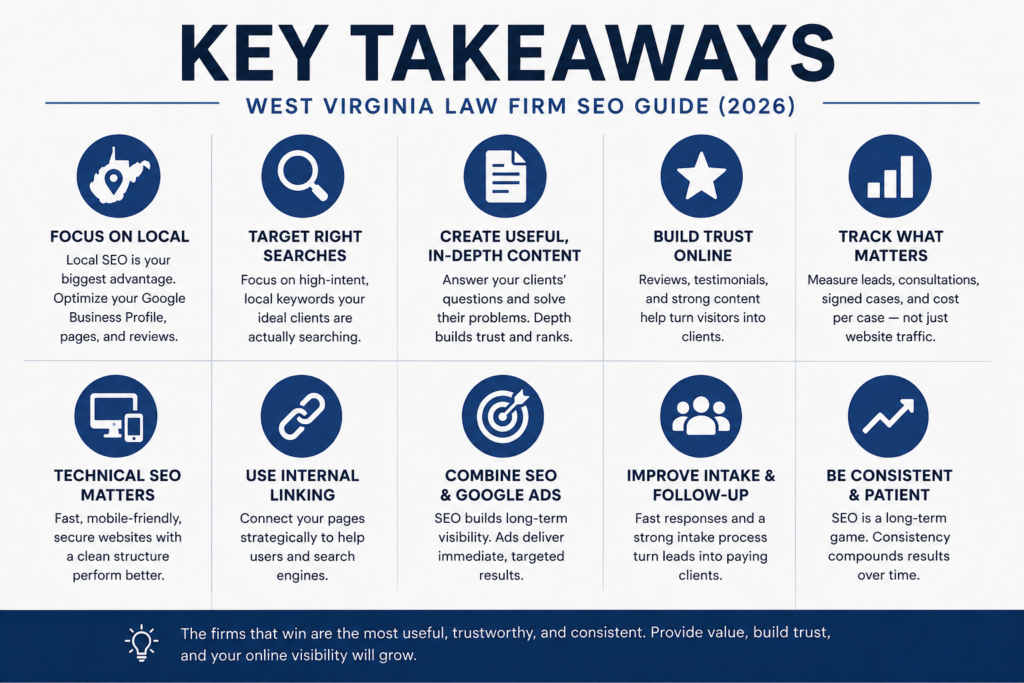
  • West Virginia Law Firm SEO Guide (2026)

    Most law firms do not have a traffic problem. They have a visibility problem, a trust problem, or a conversion problem.

    A law firm can spend thousands of dollars on SEO, Google Ads, directory listings, and content marketing — and still struggle to consistently generate consultations or signed clients. In many cases, the issue is not effort. The issue is strategy.

    For small and mid-sized firms in West Virginia, SEO can still be one of the most effective long-term marketing investments available. But the firms that succeed are usually not the firms publishing the most random blog posts. The firms that succeed understand local search intent, build trust, create useful content, and measure the right business outcomes.

    This guide breaks down what law firm SEO actually means in 2026, what matters, what does not, and how West Virginia firms can compete more effectively online.


    What Is Law Firm SEO?

    Law firm SEO (Search Engine Optimization) is the process of improving a law firm’s visibility in search engines like Google.

    The goal is simple:

    • appear when potential clients search for legal help
    • build trust
    • generate consultations
    • convert traffic into signed cases

    Examples of searches include:

    • “personal injury lawyer in Charleston WV”
    • “DUI attorney near me”
    • “West Virginia custody lawyer”
    • “how long does a lawsuit take in WV”
    • “what happens in magistrate court in West Virginia”

    SEO is not just about rankings. It is about matching the right information to the right search intent at the right time.


    Why SEO Still Matters for Law Firms

    Many legal searches are high intent.

    Someone searching for:

    • “best divorce lawyer near me”
    • “car accident lawyer Charleston WV”
    • “West Virginia estate planning attorney”

    is often not casually browsing. They may actively need legal help.

    That is why local legal SEO can still create meaningful business value.

    Unlike paid advertising, SEO can continue generating traffic long after content is published. Strong pages can attract search traffic for months or years.


    Why Most Law Firm SEO Fails

    Many firms pay for SEO but never fully understand what they are buying.

    Common problems include:

    Thin Content

    Some agencies publish dozens of low-quality articles with little substance. Google increasingly rewards depth, usefulness, and expertise.

    Generic AI Content

    AI can help with research and drafting, but mass-produced generic content often lacks originality, clarity, or practical value.

    No Local Focus

    A law firm in West Virginia does not need to compete nationally to succeed. Many firms benefit more from dominating local and regional searches.

    Weak Intake Systems

    Traffic alone does not create clients. If calls are missed or intake follow-up is inconsistent, marketing dollars are wasted.

    No Measurement

    Some firms do not track:

    • consultation rates
    • lead sources
    • signed case conversion
    • cost per lead
    • call quality

    Without measurement, it is difficult to know what is actually working.


    The West Virginia SEO Opportunity

    West Virginia presents a unique opportunity for smaller firms.

    Compared to larger metro markets:

    • competition is often lower
    • local search intent is strong
    • many firms underinvest in digital strategy
    • educational legal content is limited

    That creates openings for firms willing to:

    • publish genuinely useful information
    • improve technical SEO
    • build strong local trust signals
    • consistently update content

    Many smaller firms can compete effectively without needing national-scale marketing budgets.


    Local SEO Matters More Than Most Firms Realize

    For many law firms, local SEO is more important than broad national visibility.

    Key local SEO elements include:

    Google Business Profile

    A fully optimized Google Business Profile can significantly improve local visibility.

    Important elements include:

    • accurate categories
    • office hours
    • reviews
    • updated contact information
    • photos
    • practice area descriptions

    Reviews

    Reviews influence both rankings and trust.

    A law firm with strong reviews and responsive client communication may outperform larger competitors with weaker engagement.

    Location Pages

    Firms serving multiple counties or cities should consider dedicated pages for those regions.

    Examples:

    • Charleston WV personal injury lawyer
    • Morgantown estate planning attorney
    • Huntington criminal defense lawyer

    What Law Firms Should Actually Track

    One of the biggest mistakes firms make is focusing only on traffic.

    Traffic matters. Revenue matters more.

    Important metrics include:

    Leads by Source

    Track whether leads came from:

    • Google organic search
    • Google Ads
    • referrals
    • directories
    • social media
    • direct traffic

    Consultation Rate

    How many leads become consultations?

    Signed Client Rate

    How many consultations become paying clients?

    Cost Per Signed Case

    This is often more important than cost per click.

    Intake Response Time

    Fast follow-up can dramatically improve conversion rates.


    SEO vs Google Ads for Law Firms

    Both can work. They serve different purposes.

    SEO

    Strengths:

    • long-term traffic
    • trust building
    • compounding visibility
    • lower long-term acquisition cost

    Weaknesses:

    • slower results
    • requires consistency
    • competitive in some practice areas

    Google Ads

    Strengths:

    • immediate visibility
    • highly targeted
    • scalable

    Weaknesses:

    • expensive
    • requires ongoing budget
    • poor management can waste money quickly

    Many firms benefit from using both strategically.


    Technical SEO Still Matters

    Content alone is not enough.

    Technical SEO basics include:

    • mobile-friendly design
    • fast load speeds
    • secure HTTPS connection
    • proper page titles
    • internal linking
    • clean site structure
    • crawlable pages
    • schema markup

    A technically weak site can struggle even with strong content.


    Internal Linking Is Underrated

    Many law firm websites publish isolated articles with no structure.

    Strong sites typically organize content into:

    • pillar pages
    • practice area hubs
    • supporting articles
    • FAQ content

    Example:
    A “West Virginia DUI Guide” should link to:

    • license suspension information
    • DUI penalties
    • court process explanations
    • local county procedures

    This helps both users and search engines understand the site.


    AI and Law Firm SEO in 2026

    AI is changing legal marketing.

    Tools can help firms:

    • analyze search data
    • improve workflows
    • organize content ideas
    • summarize transcripts
    • assist with drafting

    But AI alone is not a strategy.

    The firms that benefit most from AI are usually the firms that already understand:

    • client psychology
    • legal operations
    • intake processes
    • local search behavior
    • trust building

    Human judgment still matters.


    What Small Law Firms Should Prioritize First

    Many firms try to do everything at once.

    A more practical approach is:

    1. Improve local SEO foundations
    2. Build strong practice area pages
    3. Create useful educational content
    4. Track intake and lead sources
    5. Improve conversion systems
    6. Strengthen reviews and trust signals
    7. Expand strategically over time

    Consistency usually matters more than volume.


    Final Thoughts

    SEO for law firms is becoming less about gaming algorithms and more about building genuinely useful digital experiences.

    For West Virginia law firms, the opportunity is still very real.

    Firms that:

    • understand local search intent
    • publish valuable content
    • improve intake systems
    • build trust
    • measure outcomes

    can still compete effectively online without massive national marketing budgets.

    The firms that win long-term are often not the loudest. They are the most useful, the most trustworthy, and the most consistent.


  • What Every Law Firm Should Track Weekly

    Most law firms track revenue.

    Far fewer track the numbers that actually create revenue.

    That is a problem.

    Because by the time revenue declines, the real issue often started weeks or months earlier:

    • fewer inbound leads
    • slower intake response times
    • lower consultation conversion
    • weak follow-up
    • declining search visibility
    • rising advertising costs

    The firms that grow consistently usually operate differently.

    They track leading indicators — not just financial results.

    Here are some of the most important metrics every law firm should monitor weekly.


    1. Leads by Source

    Every law firm should know exactly where inquiries are coming from.

    That includes:

    • Google organic search
    • Google Ads
    • referrals
    • social media
    • directories
    • email campaigns
    • direct website traffic

    Without source tracking, firms often continue investing in marketing channels that are not actually generating quality cases.

    Even simple tracking can reveal patterns quickly.

    For example:

    • referrals may convert at a much higher rate than paid traffic
    • certain practice area pages may generate stronger leads
    • one marketing campaign may produce volume but weak consultations

    Good marketing starts with attribution.


    2. Consultation Conversion Rate

    Getting leads is only part of the equation.

    How many actually turn into consultations?

    This metric helps identify:

    • intake quality
    • responsiveness
    • qualification issues
    • client experience problems

    For example:

    If 100 leads generate only 12 consultations, there may be:

    • poor intake scripting
    • delayed follow-up
    • confusing website messaging
    • weak trust signals
    • poor lead quality

    A firm that improves consultation conversion from 10% to 20% can dramatically increase revenue without increasing marketing spend.


    3. Signed Client Conversion Rate

    Not every consultation becomes a client.

    Tracking signed-client conversion helps firms understand:

    • attorney performance
    • pricing friction
    • trust issues
    • case selection
    • client expectations

    This is one of the clearest indicators of whether marketing and intake are aligned properly.


    4. Response Time

    Speed matters more than many firms realize.

    Potential clients are often:

    • stressed
    • emotional
    • overwhelmed
    • contacting multiple firms at once

    A delayed callback can mean a lost client.

    Law firms should track:

    • average first response time
    • missed calls
    • after-hours response handling
    • form follow-up speed

    In many markets, the firm that responds first wins.


    5. Website Traffic Trends

    Traffic alone does not guarantee business growth.

    But traffic trends still matter because they can indicate:

    • SEO improvements
    • declining rankings
    • technical issues
    • seasonal demand shifts
    • content performance

    Firms should monitor:

    • total traffic
    • organic search traffic
    • top-performing pages
    • bounce rates
    • traffic by practice area

    Weekly monitoring helps identify problems before they become major declines.


    6. Top Performing Pages

    Most law firms have a small number of pages generating the majority of traffic and leads.

    Those pages deserve attention.

    Track:

    • which pages attract traffic
    • which pages generate consultations
    • which pages convert best
    • which pages are losing rankings

    Sometimes improving one high-performing page creates more impact than publishing ten new articles.


    7. Cost Per Lead

    For firms using paid advertising, this metric is critical.

    A rising cost per lead may indicate:

    • increased competition
    • poor targeting
    • weak landing pages
    • declining ad quality
    • intake inefficiencies

    Marketing should not be evaluated only by volume.

    Efficiency matters too.


    8. Intake Follow-Up Rate

    Many law firms lose potential clients simply because follow-up stops too early.

    Potential clients may:

    • get distracted
    • hesitate
    • compare firms
    • need time to decide

    Tracking follow-up activity helps firms avoid unnecessary lead loss.

    This includes:

    • unanswered leads
    • unreturned voicemails
    • abandoned consultations
    • email follow-up completion

    9. Review and Reputation Activity

    Online reputation increasingly influences conversion.

    Firms should monitor:

    • new Google reviews
    • review response rates
    • review trends
    • reputation issues
    • referral mentions

    Trust is now part of marketing infrastructure.


    10. Signed Cases by Practice Area

    Not all leads are equally valuable.

    Tracking signed cases by practice area helps firms understand:

    • which services drive revenue
    • which content performs best
    • where marketing investment should increase
    • where profitability may be declining

    This helps firms make better long-term marketing decisions.


    Final Thought

    The law firms that grow consistently usually treat marketing, intake, and analytics as connected systems — not separate departments.

    Weekly tracking creates visibility.

    Visibility creates better decisions.

    And better decisions compound over time.

    Many firms focus heavily on getting more traffic.

    But often the biggest growth opportunities come from:

    • improving intake
    • increasing conversion
    • responding faster
    • tracking better
    • understanding where business actually comes from

    The firms that measure intelligently often grow more efficiently than the firms that simply spend more.

  • Why Most Law Firm SEO Fails (And What Attorneys Should Do Instead)

    Most law firms do not have an SEO problem.

    They have a strategy problem.

    Many firms spend thousands of dollars on websites, blog posts, Google Ads, and SEO retainers — yet still struggle to generate consistent consultations or signed clients.

    Why?

    Because modern law firm SEO is not just about publishing content or ranking for keywords anymore. It is about building trust, authority, structure, and conversion systems around the entire client journey.

    Here are some of the biggest reasons law firm SEO fails.

    For a broader overview, read our West Virginia Law Firm SEO Guide.


    1. Publishing Thin Content Instead of Useful Content

    One of the most common mistakes law firms make is creating large amounts of low-value content.

    Examples include:

    • 300-word blog posts
    • AI-generated pages with no editing
    • repetitive FAQ pages
    • dozens of near-duplicate practice area pages
    • content written only for search engines

    Google has become significantly better at identifying content that lacks depth, originality, or real usefulness.

    A law firm website with 200 weak pages often performs worse than a site with 40 strong, well-structured pages.

    The goal is not to publish more content.

    The goal is to publish better content.


    2. No Topical Authority

    Many firms create random blog posts without a clear structure.

    For example:

    • one article about car accidents
    • another about estate planning
    • another about DUI law
    • another about LLC formation

    There is no topical depth.

    Modern SEO increasingly rewards topical authority — meaning websites that thoroughly cover a subject area through interconnected content.

    A personal injury law firm should build clusters around:

    • car accidents
    • truck accidents
    • settlements
    • medical bills
    • insurance claims
    • negligence
    • court process
    • evidence
    • timelines

    The firms that win organic search often look more like digital libraries than disconnected blogs.


    3. Poor Internal Linking

    Internal linking is one of the most overlooked parts of law firm SEO.

    Every important page should connect logically to related pages.

    For example:

    • a “car accident settlement” article should link to:
      • medical bills
      • comparative negligence
      • statute of limitations
      • insurance claims
      • hiring a lawyer

    Without internal linking:

    • Google has a harder time understanding site structure
    • authority becomes diluted
    • users leave the site faster
    • important pages struggle to rank

    Strong SEO is often about architecture, not just content.


    4. Ignoring Search Intent

    Many law firms write what they want to say instead of what potential clients are actually searching for.

    A user searching:

    “What happens after a DUI arrest in West Virginia?”

    …is usually looking for:

    • process
    • timeline
    • consequences
    • next steps
    • reassurance

    They are not looking for a generic sales pitch.

    The best legal content answers real questions clearly and directly.

    Search intent matters more than keyword stuffing.


    5. Treating SEO Like a One-Time Project

    SEO is not:

    • “build website → done”

    It is an ongoing system.

    Successful firms continuously:

    • improve pages
    • update information
    • strengthen internal links
    • consolidate weak content
    • monitor rankings
    • improve conversion paths
    • refine intake processes

    SEO compounds over time.

    But neglected websites often decay over time.


    6. Ignoring Conversion and Intake

    This is where many law firms lose potential clients.

    A website may generate traffic, but:

    • nobody answers the phone
    • follow-up is slow
    • forms go nowhere
    • intake is inconsistent
    • consultation scheduling is difficult

    Traffic alone does not create revenue.

    A law firm that converts 15% of leads may outperform a firm that generates twice as much traffic but converts only 3%.

    SEO and intake should work together.


    7. Using AI Without Human Judgment

    AI can absolutely help law firms:

    • organize information
    • summarize documents
    • brainstorm content
    • improve workflows

    But blindly publishing AI-generated content often creates:

    • repetitive articles
    • factual inaccuracies
    • generic writing
    • trust issues

    The firms that succeed with AI use it as a tool — not a replacement for expertise.

    Human judgment still matters.

    Especially in legal marketing.


    8. Focusing Only on Rankings Instead of Business Outcomes

    Many SEO reports focus heavily on:

    • impressions
    • clicks
    • rankings

    Those metrics matter.

    But law firms should also track:

    • consultation requests
    • signed clients
    • lead source quality
    • cost per acquisition
    • intake conversion
    • response times

    Because rankings alone do not pay the bills.

    Clients do.


    Final Thought

    The law firms that succeed online today usually do not win because they “hack” Google.

    They win because they:

    • build trust
    • create useful content
    • organize information well
    • understand search intent
    • improve continuously
    • connect marketing with intake
    • think long-term

    SEO is no longer just a marketing tactic.

    For many firms, it has become part of the business infrastructure itself.